
In an effort to build muscles around writing more, I’m going to publish the occasional post around a topic that I’m curious about. Through these posts, hopefully we can learn together and figure out how to navigate the shifting sands of the tech landscape.
I’ve been hearing the acronym “MCP” quite a bit lately in the context of the AI swirl. Discussions that I’ve seen have been pretty opaque, so I started looking into what it actually means. I’m also curious what it means to the user experience of a product, and what the implications are for designers.
MCP—or Model Context Protocol—is an open standard, open-source framework introduced by Anthropic (the company that is building Claude) in November 2024. Its primary purpose is to standardize how artificial intelligence models, particularly large language models (LLMs), integrate and share data with external tools, systems, and data sources. To put it another way, it’s a protocol that enables LLMs to communicate with data sources and systems that it might not otherwise have access to in a way that is consistent and more easily scaled.
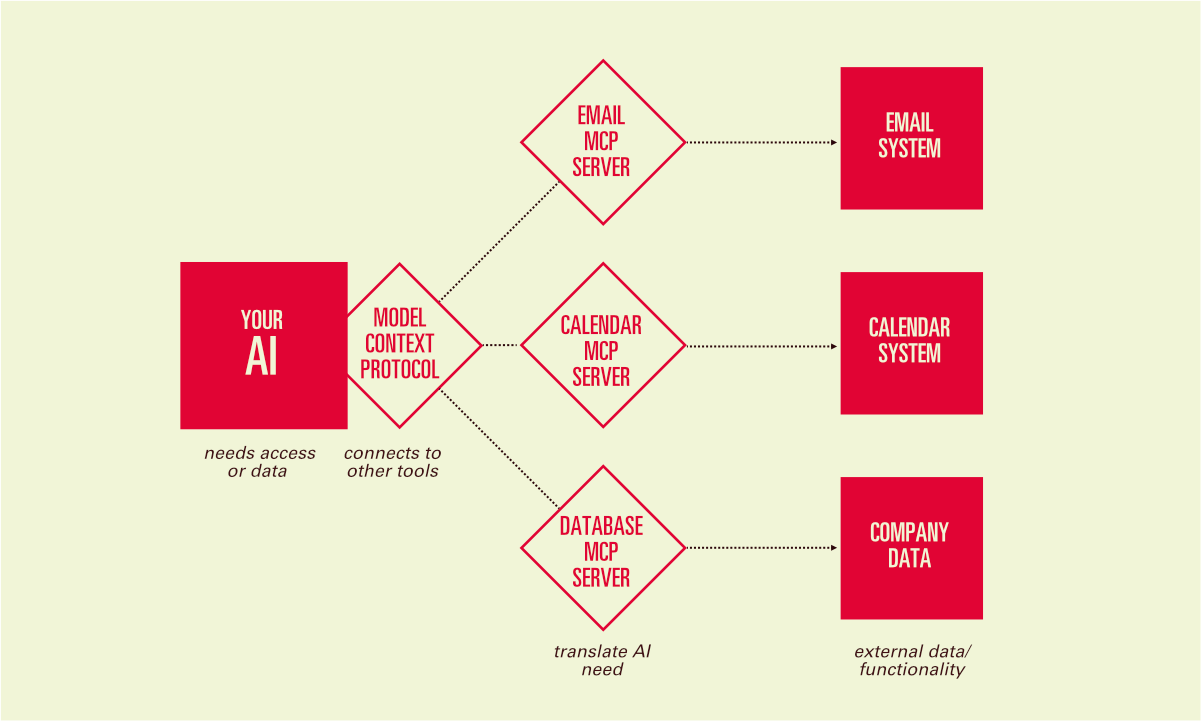
Where LLMs were previously walled off from propriety systems, they can now have controlled access in a way that doesn’t require substantial custom integrations. This allows AI agents to:
- Access relevant context: LLMs often need information beyond their training data to provide accurate and useful responses. MCP allows them to securely access real-time data from various sources.
- Take action: Beyond just providing information, MCP enables AI to perform tasks in other systems, enabling more practical and "agentic" AI experiences. The development of MCP is one of the main contributors to the rise of agentic AI discussion.
- Standardize integrations: Instead of creating custom integrations for every data source or tool, MCP provides a common protocol, making it easier to build and scale AI applications.
- Enhance collaboration: MCP facilitates secure collaboration between different AI agents or between AI and human users. That’s right, it’s not just about your AI instance talking to systems. It enables AI to effectively communicate with each other.
Some Examples
All of this is a bit abstract. Let’s make it more concrete with some clear examples. Here are 3 examples of what MCP allows an AI to do that it couldn't do previously without significant custom development for each integration:
- Real-time, Up-to-Date Information Access: Previously, an LLM's knowledge was largely confined to its training data, which could quickly become outdated. The internet isn’t static, after all. If you asked an AI about the current stock market prices, yesterday's news, or today's weather, it would either "hallucinate" or state it didn't have that information. With MCP, an AI can now connect to external "resource" servers (like financial data feeds, news APIs, or weather services) to fetch and incorporate real-time data into its responses. This transforms an AI from a static knowledge base into a dynamic, informed agent.
- Autonomous Task Execution Across Multiple Applications: Before MCP, if an AI needed to complete a multi-step task involving different software (e.g., "Find the latest customer support tickets for 'Product X', summarize them, and then create a new project in Asana with the summary"), each step would require a separate, custom-built integration. MCP enables AI to dynamically discover and utilize "tools" (functions exposed by MCP servers) across various applications. This means the AI can, for instance, fetch data from a CRM, process it, and then use another MCP server for a project management tool like Asana to create a new entry—all autonomously within a single workflow.
- Personalized Experiences with Proprietary Data: Companies often have vast amounts of internal, proprietary data (e.g., customer records, internal documents, sales figures). Without MCP, it was difficult to allow an AI to securely and contextually interact with this sensitive information. With MCP, an AI can access and reason over a company's internal knowledge bases, CRM systems, or even local files through secure MCP servers. This allows for highly personalized customer support, internal data analysis, and bespoke reporting that was previously impossible or required manual human intervention.
One thing to note in these examples is that an MCP server needs to be created first, and that server is what acts as the intermediary between the external AI and internal systems. In this way, the MCP server mediates what the AI can see, have access to, and take action on. This is a critical factor for being able to take advantage of modern LLMs without exposing a company to massive security risks. Clearly, this is a boon.
Some Possible Designer Applications for MCP
I’m a designer that often lives in the world of healthcare. One of the biggest challenges in designing for healthcare—and other regulated industries like finance—is the challenge exposing sensitive data to the wrong parties. This is one of the concerns that leads health tech companies taking a more conservative approach to new innovations. Standing up the right MCP server could allow companies to follow privacy and security regulations while also allowing teams to take advantage of the best that AI has to offer.
I mentioned agentic experiences above, and that’s potentially a huge win for users via MCP. In B2B and Enterprise software, so much of the work is to guide the user through valuable but tedious work. There are perennial challenges (e.g., finding data from multiple sources, creating worklists of actionable tasks, taking repetitive actions on multiple similar items) that could be massively simplified with agentic approaches. This prompts what the human role is in this scenario, and that continues to be a larger question relating to AI more broadly, but we owe it to our users to explore the potential of new capabilities to make their lives easer.
Wrap
I’m just scratching the surface here, but I wanted to share some thoughts soon rather than later. I’m interested to dig more into MCP and understand more about the design implications. If you’ve got questions or are similarly curious, drop a line via email or via socials (Mastodon or Bluesky).
No Comments.